

View or download the PDF print version
 | Edition January 2026 |
A Planning Tool for Intersectional Data Capacity Analysis
EXECUTIVE SUMMARY
Intersectional data lies at the heart of achieving the Sustainable Development Goals (SDGs) and ensuring no one is left behind. When excluded and marginalized communities are invisible in national statistics, they remain invisible to policymakers and excluded from essential services and interventions. Currently, only 1 in 7 SDG indicators globally contain data disaggregated by more than one population characteristic, leaving critical questions about the experiences of low-income women, migrant girls, older displaced persons, rural persons with disabilities, and other marginalized groups unanswered. This data invisibility perpetuates cycles of exclusion and undermines evidence-based policymaking.
This paper presents an actionable planning guide for national statistical offices, line ministries, civil society organizations, and communities to systematically strengthen their capacity to produce and use intersectional data. The planning guide operationalizes the Data-to-Agency-to-Policy-to-Impact framework through four interconnected dimensions:
Agency centers affected communities in identifying data priorities and ensures their lived experiences shape data collection processes;
- Agency centers affected communities in identifying data priorities and ensures their lived experiences shape data collection processes;
- Policy connects community priorities to specific policy outcomes and existing national frameworks;
- Data assesses what disaggregated information exists, identifies gaps, and determines collection pathways; and
- Enabling Environment diagnoses the technical capacity, governance structures, financing mechanisms, and stakeholder coordination necessary for sustainable intersectional data systems.
The planning guide is applied to five intersectional population groups and their representation in the SDG Global Database as a proof of concept and reveals severe data gaps. For instance, data on low-income women exist with sex disaggregation or income disaggregation, but rarely both together. Similarly, no SDG indicators currently capture the experiences of migrant girls, older forcibly displaced persons, rural persons with disabilities, or people by sexual orientation and ethnicity across their relevant policy priorities. These findings underscore how current global monitoring frameworks are not intended to support intersectional analysis. There are no data that can sufficiently support intersectional analysis on the priorities of the 2030 agenda and SDG framework, even when disaggregations are technically feasible within existing household surveys and administrative systems.
The planning guide’s primary contribution is demystifying intersectional data systems by providing a structured, participatory process that national stakeholders can implement within their own contexts, reframing intersectional data capacity in terms of reevaluating existing instruments as much as collecting new data, revealing specific gaps in national data systems and identifying concrete actions to address them; and offering a tool comparable to existing statistical planning frameworks like the Building Responsive Investments in Data for Gender Equality (BRIDGE) Tool that can be integrated into National Strategies for the Development of Statistics (NSDS).
By centering community agency alongside technical capacity, the planning guide offers a practical pathway for countries to build statistical systems that capture the diversity of their populations and enable equitable, evidence-based development for all.
INTRODUCTION
Intersectional data are defined as those data that describe individuals or groups across two or more attributes, capturing how intersecting factors shape their lived experiences. These data lie at the heart of inclusive development efforts. By examining how overlapping identities, such as gender, age, ethnicity, disability, income level, and geography, shape experiences of marginalization or privilege, intersectional data provides a nuanced understanding of social inequities. (For a deeper dive into the value of Intersectional Data along the Data Value Chain, please see this brief.) This understanding is essential for designing policies and interventions that leave no one behind, a core principle of the Sustainable Development Goals (SDGs). Despite their importance, only 1 in 7 indicators in the SDG Global database are available by more than one population attribute, which poses significant challenges to monitor the implementation of the SDGs and the fulfilment of the ambitions expressed by the targets.
This report proposes a planning guide for improving the production and use of intersectional data for achieving sustainable development. It addresses the critical need to strengthen national, regional, and global statistical systems to produce, analyze, and apply these data effectively. By focusing on this practical tool and applying it to a selected sample of SDG-relevant disaggregations, the report seeks to empower planners, statisticians, policymakers, and advocates to advance equity and social justice through improved data systems in their own contexts.
The primary audience for this research brief comprises national government stakeholders who seek guidance on initiating improvements to their statistical systems to enable intersectional analysis using intersectional development data (IDD). These individuals from national statistical offices (NSOs), line ministries, and other parts of the data systems would bring deep technical knowledge together with policy experience to an IDD planning team. They are particularly interested in understanding whom to engage within their respective country contexts to address key challenges and ensure that excluded communities receive services or are otherwise visible to government programs to ensure their representation.
The accompanying planning guide aims to support this IDD planning team by facilitating a structured approach to exploring issues and identifying solutions that align with their specific policy frameworks. Planning documents such as National Strategies for the Development of Statistics (NSDS) may also benefit from this planning guide to ensure that future plans for the statistical system build out capacity to capture the true diversity of a country’s population.
A PLANNING GUIDE FOR INTERSECTIONAL DATA
To bridge the gaps in intersectional data, this paper presents a planning guide for an IDD planning team and citizen groups, civil society organizations, and communities. The planning guide for intersectional data takes as its framework the Data to Agency to Policy to Impact framework of Badiee and Buvinic (2024) that stresses the links between disaggregated data, better agency over data, policy analysis, and impact on development outcomes summed up in Figure 1.
In this framework, data priorities are identified by starting with issues of agency and policy questions to be answered and then determining the actionable data needed. This creates a minimum list of data sets and cross-tabulations for each relevant area and context. It also shows users that building intersectional data systems is as much about reconceptualizing existing data instruments and data collection and use as it is about new sources of data.
Figure 1: Intersectionality: Data to Agency to Policy to Impact Framework
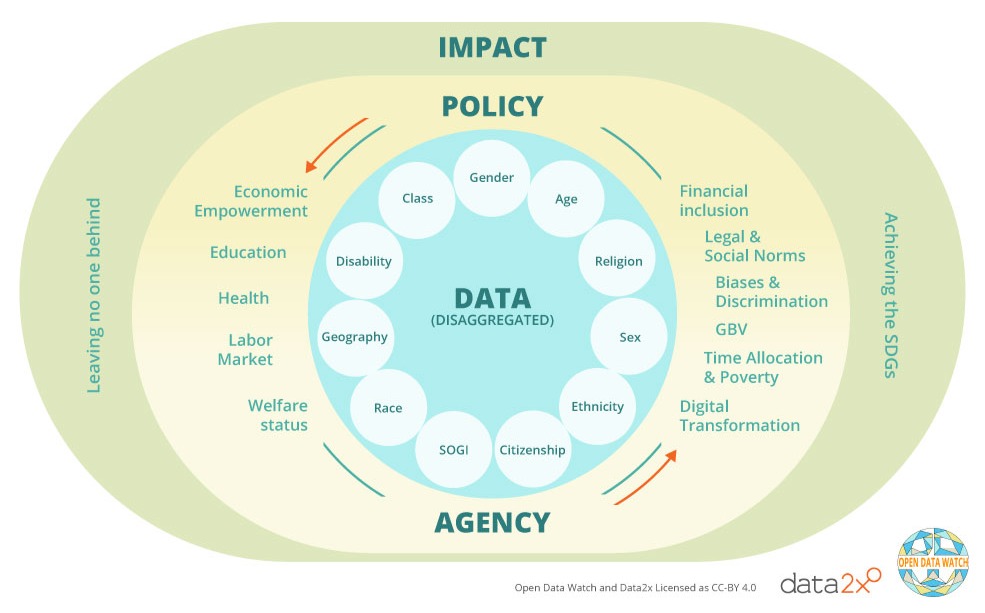
The planning guide operationalizes this framework by breaking down the assessment steps into four interrelated dimensions:
 | Agency: Central to the planning guide is the recognition of the affected communities. These individuals and communities are the most familiar with the challenges they face. The guide emphasizes their empowerment to influence data collection and analysis processes, ensuring that their priorities and lived experiences are meaningfully reflected. This participatory approach fosters trust and relevance in data systems. While agency is the starting point to thinking through how to improve data systems to include more communities, agency should be considered in all subsequent dimensions as well, such as who drafts policy, who collects data and has access to the data, and who shapes the enabling environment. |
 | Policy: Intersectional data must drive equitable policy changes to make a difference to all groups. The guide asks users to consider what specific policy questions can lead to measurable improvements in people’s lives. Policies informed by intersectional and inclusive data are better equipped to address root causes of inequality and measure progress effectively. |
 | Data: The availability of high-quality, disaggregated data is the foundation of intersectional analysis. The guide encourages the user to identify the data needed to answer the agency and policy questions. This part of the assessment will reveal gaps and limitations in existing data landscapes, offering recommendations for improvement in collection methods and accessibility for all people. |
 | Enabling Environment: For intersectional data systems to thrive, supportive institutional, financial, and technical frameworks must be in place. The guide highlights the importance of investments in capacity building, infrastructure, and partnerships to create resilient statistical systems responsive to intersectional demands. |
Agency is a key component of intersectional data analysis and should inform the spirit of the analysis. This edition of the planning guide is intended to be used at the country level by policymakers working together with relevant actors of excluded and marginalized groups. In this way, the resulting analysis will reflect their priorities. The planning guide steps through a sequence of questions that direct the user to identify groups affected by a current policy regime, identify necessary changes in policy, investigate the data needed and available to act on this subject, determine relevant stakeholders, and diagnose the enabling environment to make the statistical system responsive to the demand for intersectional data. While the analysis below chooses from a list of population groups as an illustration, the implementation of the guide should not only prioritize these groups but rather use them as a possible reference and adapt to best represent the relevant communities of each context.
The final sequence of questions guides the user in identifying priority actions to improve data instruments or an entire statistical system in a way that enables intersectional analysis. This demystification will enable actors from national statistical offices or civil society organizations and others to take steps to improve their technical capacity for intersectional analysis.
A future work program on intersectional data for the planning team would validate the proposed planning guide and global analysis in specific country statistical systems together with local stakeholders. This could be done in a stand-alone way or as part of an NSDS update process. After validation, the planning guide could then be packaged as a country tool, much like the Building Responsive Investments in Data for Gender Equality (BRIDGE) Tool.
PLANNING GUIDE QUESTIONS
Agency
The planning guide for intersectional data foregrounds the importance of people in thinking about who is included in data systems and whom these data systems should serve. Every datapoint directly or indirectly reflects one or more aspects of a person’s life and this should be reflected in thinking about who controls and is impacted by decisions taken because of data. The questions below identify the affected groups and their present involvement and concerns and start to explore ways in which these communities possess data about themselves that could be used to inform policy questions, as citizen data become increasingly part of national statistical systems. While agency should be at the start of conversations around capacity and planning for better data to enable intersectional analysis, considerations of agency and community flow throughout this guide and should be considered a part of each dimension in this framework.
|
At the end of this section of the planning guide, the IDD planning team will have defined who is affected by the current or planned policy regime and how they are engaged with the national statistical system.
Policy
Having identified the affected populations or group to be empowered through intersectional analysis, the next set of questions focuses on the policy space that is available and that intersects with the group’s needs and issues. For example, focusing on low-income older adults will lead to a consideration of data on social protection schemes, as well as employment trends, housing availability, transportation, and cultural offerings.
|
At the end of this section of the planning guide, the user will have formulated the “what” regarding what type of policy direction should be pursued to benefit the groups identified in the Agency dimension. In addition, by connecting the policy outcomes to existing policy initiatives, the answers may connect the policymaker to existing data systems or monitoring frameworks that will lead to the following dimension.
Data
With the groups identified and the relevant policy questions defined, this dimension will ask several questions to determine what data are needed to understand and act on these priorities, and what gaps or limitations exist in the current data landscape, as well as what the downstream effects of changes to existing data collection and dissemination systems will be.
|
At the end of this section, the user will have formulated an idea about the data needed to answer the policy question for the benefit of the groups identified at the start. Yet these data systems exist within enabling environments of technical capacity and governance. These conditions inform which solutions are available for improving data systems and the insights they generate to improve people’s lives.
Enabling Environment
The enabling environment for intersectional data systems is defined as the technical capacity of the national statistical system or relevant data collection authority, the governance that sets the legal bounds of activities of each of the relevant stakeholders, as well as the financial architecture that can support the improvements in the data system. These themselves have various components that will result in a comprehensive mapping of what currently exists to enable data systems that support intersectional analysis and where there are gaps.
|
These questions guide policymakers through an iterative process where each dimension builds on the others while maintaining a focus on the end goal: actionable, equity-driven outcomes. By systematically diagnosing gaps in current data systems, the planning guide enables users to identify key areas for improvement, such as disaggregation practices, data interoperability, or improving agency in data collection methods. Additionally, the process points towards potential areas of collaboration among stakeholders, ensuring that proposed solutions align with the priorities and lived experiences of diverse populations. Ultimately, the guide equips policymakers with a tailored roadmap for strengthening data systems to support robust intersectional analyses, thereby advancing equitable and evidence-based decision-making.
APPLICATION
The planning guide for intersectional data serves as a framework to enable intersectional data analysis within the specific national contexts where policymakers and other data users seek to enhance the capacity of their data systems to address questions related to intersectional issues. As proof of concept, this section applies the planning guide to the global SDGs indicators database, treating it as a proxy for the database available in a national data system.
By evaluating the guide in relation to the SDGs database, the analysis aims to assess the capacity of data systems to produce data that are necessary to take an intersectional approach on the priorities identified by the goals and targets.
In this way, this exercise also creates a suggested list of priority indicators for facilitating intersectional analysis based on a selected mix of policy priorities. These priority indicators are illustrative only of this exercise and demonstrate how following the planning guide will lead users to define their own priority indicators to focus on for improvement and monitoring. Future applications of this planning guide may include a case study of a national database in partnership with the NSO to identify and plan for the collection of intersectional data relevant for this context.
The Inter-Agency and Expert Group on Sustainable Development Goal Indicators (IAEG-SDGs) has outlined policy priorities for data disaggregation of population groups needed for the SDG indicators to address crucial policy questions that are relevant to national development. While this example focuses on a globally agreed upon set of policy priorities and population groups, country representatives or other stakeholders should take their relevant population groups and their respective policy priorities into consideration to ensure that addressing the data gaps in their data system will enable them to answer their policy questions to take action to improve people’s lives. These insights could then be used to inform statistical planning.
The document defines several population groups for priority in disaggregating data to enable more nuanced policy analysis: low-income people, women and girls, children, older persons, international migrants, forcibly displaced persons, persons with disabilities, and geographic location. To test the SDGs database in relation to intersectional data, this analysis will combine disaggregations as follows: Low-income women, migrant girls, older forcibly displaced persons, rural persons with disabilities, and adding Sexual Orientation and Gender Identity (SOGI) status and ethnicity. These intersectional population groups are defined as illustrative examples for this planning guide and do not necessarily indicate priority population groups for each country and context. Planners, statisticians, and community members will choose their most relevant population groups to identify existing data, gaps in capacity, and ways to improve data availability and use according to the planning guide outlined above.
The planning guide envisions the IDD planning team and representatives of these communities to decide on crucial policy priorities together. In this illustrative example, the IAEG-SDGs has already set the policy priorities for their population groups. After combining some of the population groups as specified above, the policy priorities to be examined will be as follows:
- Low-income women: inclusive and pro‐poor growth; social protection systems and floors; and effective governance, including participation and use of available resources.
- Migrant girls: poverty eradication; food insecurity and health; education; access to economic resources and decent work for all; and gendered impacts of climate change.
- Older internally displaced persons: health; income security; violence, abuse, and safety; and empowerment and participation as full members of society.
- Rural persons with disabilities: Poverty eradication, Education, Employment, Health, WASH, and Accessibility.
- The IAEG-SDG document does not define policy priorities for people by SOGI status or ethnicity, but for this analysis, the relevant policy priorities are specified as health, safety, and poverty.
In a use case in each country and IDD planning team, the population groups and policy priorities would be set by each team to assess the ability of their data system to generate and disseminate the data needed to analyze the conditions for these population groups along these policy priorities. In the following section, the agency, policy, data, and enabling environment will be analyzed for each of the population groups identified above.
Global Analysis
Before examining the specific population groups and their policy priorities for the global community as a proxy for how this analysis would be conducted at the country level, we can take a more constrained approach to intersectional data analysis, one only defined by disaggregated data instead of the emphasis on agency and policy relevance as espoused by this planning guide. In this way, we are able to use a tool by the UN Statistics Division to examine the data availability of SDG indicators broken down by their disaggregations (not always strictly population groups disaggregations). This gives us the widest possible snapshot of the availability of intersectional data, defined in this example only by the presence of datapoints on more than one disaggregation.
As of the Q3 2024 update of the SDG Global Database, 32 out of 231 unique indicators (or 1 in 7 indicators) have at least one datapoint for more than 1 disaggregation. Since 2015, for example, SDG indicator 8.8.1 on the fatal and non-fatal injuries has disaggregations for workers by sex and migrant status. This drops to 26 out of 231 (or 1 in 9 indicators) when looking at data with at least two years of data since 2015. Half of the indicators currently available for intersectional analysis are disaggregated by sex and age (15 indicators with at least one datapoint available for sex and age since 2015). This includes indicators like SDG indicator 5.4.1 on time spent on unpaid and domestic care work. This makes questions about older women or young men the most plausible for intersectional analysis in the current indicator set, but still only for just over 5 percent of all indicators.
This macro-level analysis has revealed that there are indicators available for intersectional data analysis from the SDG global database when looking only at the availability of disaggregations for two or more population groups. However, the fact that this sample of indicators still only constitutes a maximum of 14% of indicators when using all data since 2015 underscores how much more work is needed to produce data on population groups that are currently invisible. This will be further explored in the more detailed analysis to follow.
Data about low-income women
Following the structure of the planning guide, the following analysis steps through each of the dimensions to arrive at an analysis of where there are gaps in the capacity to produce data to inform intersectional data analysis based on the SDG targets’ priorities and indicators in the SDG global database.
Agency: In this scenario, low-income women have not been represented formally as a specific interest group. Nevertheless, they have articulated concerns, namely, access to finance, income safety, and lack of decision-making power. Sporadic data have been collected by and about low-income women, but not regularly enough to integrate into formal policy formulation.
Policy: The policy concerns voiced by this community are mirrored in the policy priorities of the IAEG-SDG policy priorities of Inclusive and Pro‐Poor Growth, Social Protection Systems and Floors, and Effective Governance, including Participation and Use of Available Resources. At the level of the SDGs, Agenda 2030 itself is the closest policy document that sets these policy priorities and champions the principles of inclusiveness, which is the start for generating data on all population groups.
Data: To speak to these policy concerns, quantitative data are needed to capture the experiences of this group, which can be complemented with similarly disaggregated qualitative data on experiences with these policies to consider the lived experience of population groups, such as with social protection policies. Both qualitative and quantitative indicators should be disaggregated by sex or gender and income status to capture the experience of low-income women.
Each policy concern is matched with an indicator that would help monitor progress for the population group and the related underlying data would inform policy formulation. The availability of data for the required disaggregations is then assessed and gaps are identified. The way forward is presented by identifying which instrument needs to be improved and who will oversee data collection.
Inclusive and pro-poor growth:
- Indicator 10.2.1: Proportion of people living below 50 per cent of median income, by sex, age and persons with disabilities.
- Data are not available with sex disaggregation but there is disaggregation for the bottom 50%, however, this is the only disaggregation available. There is time series data.
- Data are needed by sex disaggregation and other recommended disaggregations as explained in the metadata.
Social Protection Systems and Floors:
- Indicator 1.3.1: Proportion of population covered by social protection floors/systems, by sex, distinguishing children, unemployed persons, older persons, persons with disabilities, pregnant women, newborns, work-injury victims and the poor and the vulnerable
- Data with sex disaggregation exist by specific social protection program (i.e. maternity, unemployment, child/family, work injury cash benefits). Timeseries is inconsistent. Income status (total and lowest quantile) information exists for some data series, but no series have sex disaggregation AND income status.
- Ensure that there are more frequent data and enable disaggregation for sex AND income.
Effective Governance, Including Participation and Use of Available Resources:
- Indicator 5.5.1: Proportion of seats held by women in (a) national parliaments and (b) local governments.
- There are time series data with sex disaggregation but there is no disaggregation by income status as well.
- Ensure that there is additional disaggregation by income status.
Data recommendation: These data are sourced mainly from household surveys and administrative systems in the case of social protection and legislative representation data. The NSOs and other parts of the national statistical system can work with interest groups to generate more data on sex AND income status through these instruments to make sure these indicators can be used to address the policy concerns of low-income women.
Enabling environment: Sustainable, high-quality data systems that address the needs of low-income women require robust financial and institutional support, including statistical laws, strategies focused on gender equality, and civil rights protections. For this analysis of the global availability of data, only general recommendations about the enabling environment can be applied: Collaborations with the Global Fund for Women, UN Women, civil society, academia, and the private sector can enhance the collection and analysis of data that reflect the realities faced by low-income women. Mechanisms such as the SDG global database and its related reports provide accessible insights to communities while addressing concerns about how data on low-income women are collected and used. Feedback systems, including engagement with civil society and inclusiveness working groups, are essential for refining data collection and policymaking processes to respond effectively to the specific needs of low-income women through an intersectional lens.
Data about migrant girls
Following the structure of the planning guide, the following analysis steps through each of the dimensions to arrive at an analysis of where there are gaps in the capacity of the SDG global database to present data to enable intersectional data analysis.
Agency: In this scenario, migrant girls have not been represented formally as a specific interest group. Nevertheless, they have articulated concerns, the ability to support themselves and their families, good nutrition for continued growth, good education, economic empowerment, and the impact of natural disasters as a precipitation of their migration and well-being on the move. Sporadic data has been collected by and about migrant girls, including in collaboration with multilateral agencies like UNHCR but not regularly enough to integrate into formal policy formulation.
Policy: The policy concerns voiced by this community are mirrored in the policy priorities of the IAEG-SDG policy priorities of Poverty Eradication, Food Insecurity and Health, Education, Access to Economic Resources, and Gendered Impacts of Climate Change. At the level of the SDGs, Agenda 2030 itself is the closest policy document that sets these policy priorities and champions the principles of inclusiveness, which is the start for generating data on all population groups.
Data: To speak to these policy concerns, quantitative data are needed to capture the experiences of this group, which can be complemented with similarly disaggregated qualitative data on lived experiences with these policies, such as coping mechanisms for food insecurity. Both quantitative and qualitative indicators should be disaggregated by sex or gender, age, and international migration status to capture the experience of migrant girls.
Each policy concern is matched with an indicator that would help monitor progress for the specific population group. The related underlying data would inform policy formulation. The availability of data for the required disaggregations is then assessed and gaps are identified. The way forward is presented by identifying which instrument needs to be improved and who will oversee data collection.
Poverty Eradication:
- Indicator 1.1.1: Proportion of the population living below the international poverty line by sex, age, employment status and geographic location (urban/rural)
- Data are not available with the needed disaggregations to cover migrant girls; however, there is aggregated timeseries data.
- Data are needed by sex and migrant status and other recommended disaggregations as called for in the metadata.
Food Insecurity and Health:
- Indicator 2.1.2: Prevalence of moderate or severe food insecurity in the population, based on the Food Insecurity Experience Scale (FIES)
- Data are not available with the needed disaggregations to cover migrant girls; however, there is aggregated timeseries data.
- Data are needed by sex and migrant status and other recommended disaggregations as called for in the metadata.
Education:
- Indicator 4.4.1: Proportion of youth and adults with information and communications technology (ICT) skills, by type of skill
- Data are not available with the needed disaggregations to cover migrant girls; however, there is timeseries data by sex, but it’s not enough to capture migrant girls.
- Data are needed by sex and migrant status and other recommended disaggregations as called for in the metadata.
Access To Economic Resources and Decent Work for All:
- Indicator 8.3.1: Proportion of informal employment in total employment, by sector and sex
- Data are not available with the needed disaggregations to cover migrant girls; however, there is timeseries data by sex, but it’s not enough to capture migrant girls.
- Data are needed by sex and migrant status and other recommended disaggregations as called for in the metadata.
Gendered Impacts of Climate Change:
- Indicator 13.1.1: Number of deaths, missing persons and directly affected persons attributed to disasters per 100,000 population.
- Data are not available with the needed disaggregations to cover migrant girls; however, there is aggregated timeseries data.
- Data are needed by sex and migrant status and other recommended disaggregations as called for in the metadata.
Data recommendation: These data are sourced mainly from household surveys. The NSOs and other parts of the national statistical system can work with interest groups to generate more data on sex AND international migrant status in these instruments to make sure these indicators can be used to address the policy concerns of migrant girls.
Enabling environment: Sustainable, high-quality data systems that address the needs of migrant girls require strong financial and institutional support, including statistical laws, strategies focused on equality and inclusion, and protections for civil rights. For this analysis of the global availability of data, only general recommendations about the enabling environment can be applied: Partnerships with Women in Migration Network and Refugees International, other civil society organizations, academia, and the private sector are vital for enhancing the collection and analysis of data that capture the unique experiences of migrant girls. Mechanisms such as the SDG global database and its associated reports play a key role in providing communities with accessible insights while addressing concerns about the collection and use of data on migrant girls. Feedback systems, including collaboration with civil society and inclusiveness working groups, are crucial for refining data collection and policymaking processes to respond effectively to the distinct challenges faced by migrant girls through an intersectional approach.
Data about older forcibly displaced persons
Following the structure of the planning guide, the following analysis steps through each of the dimensions to arrive at an analysis of where there are gaps in the capacity of the SDG global database to present data to enable intersectional data analysis.
Agency: In this scenario, older forcibly displaced persons have not been represented formally as a specific interest group. Nevertheless, they have articulated concerns, namely staying healthy, continuing to be able to provide for themselves, staying safe while on the move, and being able to have a voice and agency. Sporadic data has been collected by and about older forcibly displaced persons, but not regularly enough to integrate into formal policy formulation.
Policy: The policy concerns voiced by this community are mirrored in the policy priorities of the IAEG-SDG policy priorities of Health, Income Security, Violence, Abuse, And Safety, and Empowerment and Participation as Full Members of Society. At the level of the SDGs, Agenda 2030 itself is the closest policy document that sets these policy priorities and champions the principles of inclusiveness, which is the start for generating data on all population groups.
Data: To speak to these policy concerns, quantitative data are needed to capture the experiences of this group, which can be complemented with similarly disaggregated qualitative data on lived experiences with these policies. Both quantitative and qualitative indicators should be disaggregated by sex or gender, age, and internal displacement status to capture the experience of older forcibly displaced persons.
Each policy concern is matched with an indicator that would help monitor progress for the population group, The related underlying data would inform policy formulation. The availability of data for the required disaggregations is then assessed and gaps are identified. The way forward is presented by identifying which instrument needs to be improved and who will oversee data collection.
Health:
- Indicator 2.1.1: Prevalence of undernourishment
- Data are not available with the needed disaggregations to cover older forcibly displaced persons; however, there is aggregated timeseries data.
- Data are needed by age, sex and migrant status.
Income Security:
- Indicator 1.2.2: Proportion of men, women and children of all ages living in poverty in all its dimensions according to national definitions
- Data are not available with the needed disaggregations to cover older forcibly displaced persons; however, there is aggregated timeseries data.
- While multidimensional poverty covers many dimensions, such as education, health, and so forth. To have a further multidimensional lens, data need to be further disaggregated by age, gender/sex, migration status to capture older displaced persons.
Violence, Abuse, And Safety:
- Indicator 11.7.2: Proportion of persons victim of non-sexual or sexual harassment, by sex, age, disability status and place of occurrence, in the previous 12 months.
- Data are not available with the needed disaggregations to cover older forcibly displaced persons; however, there is aggregated timeseries data.
- Data are needed by age, sex and migrant status.
Empowerment And Participation as Full Members of Society:
- Indicator 16.7.2: Proportion of population who believe decision-making is inclusive and responsive, by sex, age, disability and population group
- Data are not available with the needed disaggregations to cover older forcibly displaced persons; however, there is aggregated timeseries data.
- Data are needed by sex, age and migrant status and other recommended disaggregations laid in the metadata.
Data recommendation: These data are sourced exclusively from household surveys. The NSOs and other parts of the national statistical system can work with interest groups to generate more data on sex, age AND internal displacement status in these instruments to make sure these indicators can be used to address the policy concerns of older forcibly displaced persons.
Enabling environment: Sustainable, high-quality data systems that address the needs of older forcibly displaced persons require strong financial and institutional support, including statistical laws, strategies focused on inclusion and equity, and protections for civil rights. For this analysis of the global availability of data, only general recommendations about the enabling environment can be applied: Partnerships with HelpAge International, other civil society groups, academia, and the private sector are essential for improving the collection and analysis of data that reflect the lived experiences of older forcibly displaced persons. Mechanisms such as the SDG global database and its associated reports provide accessible insights to communities while addressing concerns about the collection and use of data on this population. Feedback systems, including collaboration with civil society and inclusiveness working groups, are critical for refining data collection and policymaking processes to address the unique challenges faced by older forcibly displaced persons through an intersectional lens.
Data about rural persons with disabilities
Following the structure of the planning guide, the following analysis steps through each of the dimensions to arrive at an analysis of where there are gaps in the capacity of the SDG global database to present data to enable intersectional data analysis.
Agency: In this scenario, rural persons with disabilities have not been represented formally as a specific interest group. Nevertheless, they have articulated concerns, namely challenges in being able to access goods and services, getting an education like everyone else, getting a job, staying healthy, and being able to navigate their environment. Sporadic data has been collected by and about rural persons with disabilities, but not regularly enough to integrate into formal policy formulation.
Policy: The policy concerns voiced by this community are mirrored in the policy priorities of the IAEG-SDG policy priorities of Poverty eradication, Education, Employment, Health, and Accessibility. At the level of the SDGs, Agenda 2030 itself is the closest policy document that sets these policy priorities and champions the principles of inclusiveness, which is the start for generating data on all population groups.
Data: To speak to these policy concerns, quantitative data are needed to capture the experiences of this group, which can be complemented with similarly disaggregated qualitative data on lived experiences with these policies, for example with service provision. Both quantitative and qualitative indicators should be disaggregated by geographic location and disability status to capture the experience of rural persons with disabilities.
Each policy concern is matched with an indicator that would help monitor progress for the population group. The related underlying data would inform policy formulation. The availability of data for the required disaggregations is then assessed and gaps are identified. The way forward is presented by identifying which instrument needs to be improved and who will oversee data collection.
Poverty eradication:
- Indicator 1.2.1: Proportion of population living below the national poverty line, by sex and age
- Data are not available by disability status. Data are available for urban areas for some countries, including in time series
- Data are needed by disability status and for rural areas, and then datapoints should be published for disability AND rural area status
Education:
- Indicator 4.1.1: Proportion of children and young people (a) in grades 2/3; (b) at the end of primary; and (c) at the end of lower secondary achieving at least a minimum proficiency level in (i) reading and (ii) mathematics, by sex
- Data are not available by disability status nor by geographic location
- Data are needed by disability status and by geographic location
Employment:
- Indicator 8.5.1: Average hourly earnings of employees, by sex, age, occupation and persons with disabilities
- Data are not available by disability status nor by geographic location
- Data are needed by disability status and by geographic location
Health:
- Indicator 3.8.1: Coverage of essential health services
- Data are not available by disability status nor by geographic location
- Data are needed by disability status and by geographic location
Accessibility:
- Indicator 17.8.1: Proportion of individuals using the Internet
- Data are not available by disability status nor by geographic location
- Data are needed by disability status and by geographic location
Data recommendation: These data are sourced from surveys, censuses, and establishment surveys. The NSOs and other parts of the national statistical system can work with interest groups to generate more data on geographic location and disability status in these instruments to make sure these indicators can be used to address the policy concerns of rural persons with disabilities. In addition, where data may be available for persons with disabilities but not published in the official database, custodian agencies and the IAEG-SDG could collaborate on exploring the potential of adding such data.
Enabling environment: Sustainable, high-quality data systems that address the needs of rural persons with disabilities require strong financial and institutional support, including statistical laws, strategies focused on inclusion and accessibility, and protections for civil rights. For this analysis of the global availability of data, only general recommendations about the enabling environment can be applied: Partnerships with organizations such as the Washington Group on Disability Statistics, civil society, academia, and the private sector are essential for enhancing the collection and analysis of data that reflect the unique experiences of rural persons with disabilities. Mechanisms such as the SDG global database and its associated reports provide accessible insights to communities while addressing concerns about the collection and use of data on this population. Feedback systems, including collaboration with civil society and inclusiveness working groups, are crucial for refining data collection and policymaking processes to respond effectively to the challenges faced by rural persons with disabilities through an intersectional approach.
Data about people by SOGI status and ethnicity
Following the structure of the planning guide, the following analysis steps through each of the dimensions to arrive at where there are gaps in the capacity of the SDG global database to present data to enable intersectional data analysis.
Agency: In this scenario, people by SOGI status and ethnicity have not been represented formally as a specific interest group. Nevertheless, they have articulated concerns, namely staying healthy, staying safe, and being able to earn a living. Sporadic data has been collected by and about people by SOGI status and ethnicity, but not regularly enough to integrate into formal policy formulation.
Policy: The policy concerns voiced by this community are mirrored in the policy priorities of the IAEG-SDG policy priorities of Health, Safety, and Poverty. At the level of the SDGs, Agenda 2030 itself is the closest policy document that sets these policy priorities and champions the principles of inclusiveness, which is the start for generating data on all population groups.
Data: To speak to these policy concerns, quantitative data are needed to capture the experiences of this group, which can be complemented with similarly disaggregated qualitative data on lived experiences with these policies. Both quantitative and qualitative indicators should be disaggregated by SOGI status and ethnicity to capture the experience of people by SOGI status and ethnicity.
Each policy concern should be matched with an indicator that would help monitor progress for the specific population group, leading to identifying the underlying data that would inform that policy. The availability of data for the required disaggregations could then be assessed and gaps are identified. The way forward is presented by identifying which instrument needs to be improved and who will oversee data collection.
Health:
- Indicator 3.3.1: Number of new HIV infections per 1,000 uninfected population, by sex, age and key populations
- Data are not available by SOGI status nor by ethnicity
- Data are needed by SOGI status and by ethnicity
Safety:
- Indicator 11.7.1: Average share of the built-up area of cities that is open space for public use for all, by sex, age and persons with disabilities
- Data are not available by SOGI status nor by ethnicity
- Data are needed by SOGI status and by ethnicity
Poverty:
- Indicator 1.4.1: Proportion of population living in households with access to basic services
- Data are not available by SOGI status nor by ethnicity
- Data are needed by SOGI status and by ethnicity
Data recommendation: These data are sourced from census, household surveys and administrative records. NSOs and other parts of the national statistical system can work with interest groups to generate more data on SOGI status and ethnicity in these instruments to make sure these indicators can be used to address the policy concerns of people by SOGI status and ethnicity.
Enabling environment: Sustainable, high-quality data systems that address the needs of people based on SOGI status and ethnicity require robust financial and institutional support, including statistical laws, strategies promoting inclusion and equity, and protections for civil rights. Partnerships with organizations such as Koppa’s Consortium for LGBTI+ Inclusive Data, other parts of civil society, academia, and the private sector are essential for enhancing the collection and analysis of data that capture the intersecting experiences of individuals by SOGI status and ethnicity. Mechanisms such as the SDG global database and its associated reports provide accessible insights to communities while addressing concerns about the collection and use of data on these populations. Feedback systems, including strong dissemination of existing data and analysis through various media as well as engagement with civil society and inclusiveness working groups, are critical for refining data collection and policymaking processes to address the specific challenges faced by people at the intersection of SOGI status and ethnicity through an intersectional framework.
CONCLUSION
This paper highlights the critical importance of intersectional data for advancing equity and achieving the Sustainable Development Goals (SDGs) and offers a path from the IDD concept and framework to implementation and realization of IDD through a planning guide. The planning guide introduced here provides a structured approach to understanding and addressing the gaps in intersectional data systems, emphasizing four key dimensions: agency, to empower affected communities in shaping data processes; policy, to ensure data-driven and equitable policy interventions; data, to identify gaps and prioritize the collection of disaggregated information; and enabling environment, to build institutional, financial, and technical frameworks that creates visible impacts and support responsive statistical systems.
This research has paved a path through a step-by-step approach to demystify the state of IDD at national level. These steps were used to test the SDG indicators and how they meet the IDD criteria set. Applying this guide to the evaluation of priority population groups and associated policy priorities revealed significant shortcomings in the availability and use of intersectional data across the global SDG indicator framework. While sex disaggregation is available, its intersection with many other disaggregations, like migrant status, geographic location, and disability status is severely lacking. Similarly, SOGI data are not possible to find in the SDG global database.
These gaps hinder the ability to assess disparities and track progress effectively, particularly for vulnerable groups whose needs are often overlooked. The findings underscore the pressing need for coordinated efforts to improve statistical capacity, including investments in disaggregation methods, data infrastructure, and training programs.
Equally important is the need for sensitivity training to enhance awareness of the role of intersectionality in data systems and building analysis and planning skills among policymakers, statisticians, and other stakeholders. By fostering an inclusive culture within statistical systems, decision-makers can better capture and act on the nuanced realities of inequality, ensuring that no one is left behind. Strengthening these systems and processes is not merely a technical challenge but a moral imperative to advance sustainable and equitable development for all.
NEXT STEPS AND ACKNOWLEDGEMENTS
The team looks forward to engaging with other stakeholders in responding to this framework. In the future, this planning guide, once tested in a few country case studies, could be presented as a stand-alone tool for use by stakeholders along with other IDD products such as the advocacy brief including the Data Value Chain. In parallel, through further engagement with international standard setters and with the development data custodian agencies working on modernization of NSDS tools, the team will advocate for further inclusion of intersectional thinking in global frameworks such as the SDG monitoring framework and in the post-2030 conversation.
This planning tool was authored by Lorenz Noe, Research Manager at Open Data Watch, with support from the Open Data Watch team, including Shaida Badiee, Francesca Perucci, and Eric Swanson. The author wishes to extend a special thanks to the reviewers who improved the draft with their comments and feedback: Mayra Buvinic (Center for Global Development & Data2X), Camilo Mendes (DANE), Yongyi Min (United Nations Statistics Division), and Elizabeth Lockwood (CBM Global Disability Inclusion).
Contact us at: info@opendatawatch.com