
|
| Edition |

.
.
.
.
.
.
.
Prepared by Open Data Watch and Data2X
PROMOTING GENDER DATA USE:
COLLECTIVE ACTION FOR GREATER IMPACT
View PDF version
Gender data are shaping policies and actions around the world, but collective action is needed to achieve their full impact.
The importance of data that document the realities facing women and girls is already visible. In Vietnam, data on violence against women have informed national action plans and campaigns. And in Finland, data showing disparities between how men and women spend their time have informed policies on parental leave, childcare, domestic services, and rural women’s employment.
This brief shares examples of how a wide range of stakeholders can collaborate to help put gender data to use – from improving usability to policies, capacity, and funding. And it distills how they can enable that use.
KEY MESSAGES:
- Demonstrating impact of gender data use is key. As their full potential becomes more apparent, this will further strengthen efforts to enable use.
- Policies, such as data sharing policies, can promote gender data use, but their implementation and everyday practices are what create real change.
- Building capacity to use gender data and understand gender issues allows more people to use their skills to turn data into action.
- Providing data that are fit for purpose and in open formats will ensure that available gender data can be used.
- Funding from national and international sources makes these support efforts possible when it targets and promotes gender data use.
- All stakeholders must work together to promote and entrench gender data use.
What do we mean by gender data use?
The publication of gender data does not result in automatic use.
Just as gender data production involves a range of processes, so does their use. The processes of collection and publication are well understood. But the uptake and impact stages are often ignored or assumed to be self-fulfilling. What do each of these stages and their processes entail?
The data value chain visualizes the processes of data production and use.

When gender data are used to write a report or develop an app to connect others to the data, this is “use for uptake.”
Uptake involves connecting users with gender data and making data use easier. Once data are available (collected and published), connecting users with them can take many forms such as disseminating a report that someone will use to inform a decision. It can involve developing an app that transforms the data into a more accessible format. Making data uptake easier involves reducing the cost and increasing the value of their use. Data literacy training can encourage effective use. And promoting a culture of data use stimulates further use.
When using gender data results in change, this is “use for impact.”
Impact happens when gender data use informs a decision, alters a condition, or improves well-being. A wide spectrum of efforts is needed across the uptake stage to reach this point. What defines data use here is its connection to change. Advocates use a report to design policies that result in more equitable resource allocation. Citizens use an app that puts crucial information at their fingertips to inform their choices. This is what makes all the time, effort, and resources worthwhile. And through this stage, we arrive at re-use, which reflects the systemic, habitual use of gender data.
Collective action to enable gender data use
The experience of many countries demonstrates that promoting gender use requires the collective action of many actors and stakeholders.

Data producers make available data usable, and their involvement in promoting data use is crucial. They partner with user groups to build the awareness and capacity they need. And they maintain open feedback loops to inform better data production and build trust.

Decision-makers promote a culture of data use. They create opportunities to build capacity and reward use in practice. And they can cement these practices by establishing policies that mandate data use. Implementing both the letter of the law and the spirit is crucial for use.

Advocates make the case for strong use policies and practice. They call for and take part in capacity building and then put that capacity to use for uptake and impact. And they make the case for the funding necessary to sustain gender data use activities.

Funders serve the crucial role of providing resources to support gender data use. They emphasize the importance of data use and motivate building systems that encourage better data use. They fund user feedback, better websites, and adherence to open data principles.
A single person could serve in more than one of these roles. And these roles are found across all sectors.
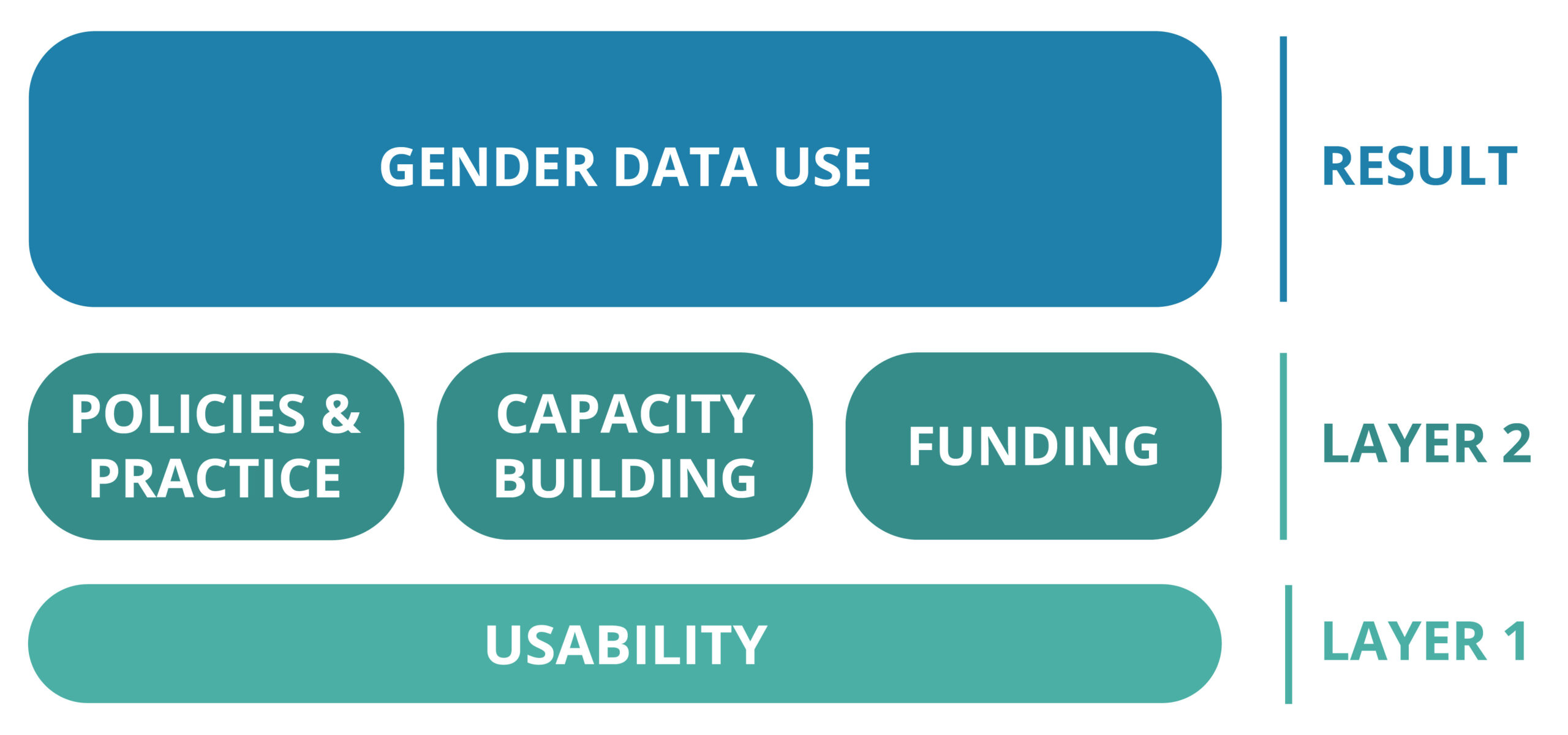
Many opportunities exist for different stakeholders to support gender data use. As the figure shows, these opportunities can be understood in two layers. First are efforts towards improving usability to ensure that available gender data are fit for purpose and open for use. Second are policies and practices, capacity building, and funding. The combination of these efforts support gender data use for impact.
Figure 1: The two layers of opportunities to support gender data use
The following sections explore the opportunities in these layers and share examples from countries around the world.
Usability: Producing gender data that meet user needs
Usable gender data create a foundation for all other efforts to promote gender data use. While gender data have become more available in recent years, more work is needed to ensure they meet user needs.
Engaging with users to understand their needs will help make gender data fit for purpose. Data should answer relevant questions, at the right level of disaggregation and be provided at the necessary frequency. Opportunities exist to engage with users through survey design, collection, and publication. Active engagement and outreach also help create awareness of the data among users and build their trust in them, increasing the likelihood of uptake.

Photo: Yuri A / Shutterstock.com
IN FINLAND: Involving data users
Since 1979, Statistics Finland has measured disparities between how men and women spend their time. Government agencies who fund time use surveys serve as expert advisors to help ensure the data will be useful for decision-making. This process has created awareness and ownership over the data, informing policies on parental leave, childcare, domestic services, and rural women’s employment.
Source: Data2X. (2019). Using Data to Address the Unpaid Work Burden: A Case Study of Finland. bit.ly/4lnxUMo
For users to access and work with gender data, the data must be open for use. This means they must be available in open formats, include metadata, and have open terms of use. An open format means a user can download the data in machine-readable formats and process them using non-proprietary software. Metadata provide definitions and other details to inform their analysis or interpretation. And an open terms of use or data license provides permission to freely use the data.
Gender data are less open than other types of data such economic or financial data. A lot of gender data are only published in stand-alone reports, and we don’t find them widely integrated or mainstreamed into national data portals.
Figure: Average openness scores of gender and non-gender data

Source: Open Data Watch. (2023). Gender Data Compass. bit.ly/449e15N
Policies and Practice: A crucial combination
Policies promoting gender data use must be paired with practices that create a culture of gender data use. Policies can include everything from statistical laws that mandate support for use to data sharing agreements or staff training requirements.
Putting these policies into practice will be essential. There are opportunities for all stakeholders to promote a culture of data use. Although the mandate of data producers and data stewards have often focused on production, modern statistical systems include promoting use as part of their mandate. Even in the absence of official policies to promote gender data, anyone can work to create a culture of gender data use. And once practices are in place, it will be all the more feasible to cement them through official policies.
IN JORDAN: Strengthening data use policies
In 2021, UN Women, the Department of Statistics, and the Ministry of Planning and International Cooperation formalized a partnership to address the limited analysis and use of statistics. This partnership established a Memorandum of Understanding to strengthen the policies and practices that govern the production and use of gender statistics. This supported the development of knowledge products using gender data.
Source: UN Women (2022). “Making Every Woman and Girl Count in Jordan”. bit.ly/3ZHNdXN

Photo: leshiy985 / Shutterstock.com
IN GHANA: Promoting the practice of data use
Despite the availability of gender data, parliamentary decision-making was most often guided by chance and perception rather than evidence. In 2021, the Ghana Statistical Service and Africa Centre for Parliamentary Affairs collaborated with academic institutions and received support from the Data For Now Initiative to organize the Data Fair. Workshops, seminars, and interactive sessions enabled Members of Parliament to develop interest and appreciation for the transformative power of data in their work.
Source: Hansen et al. (2024). Collaboration between national statistical offices and academia. bit.ly/4k7Ro6z
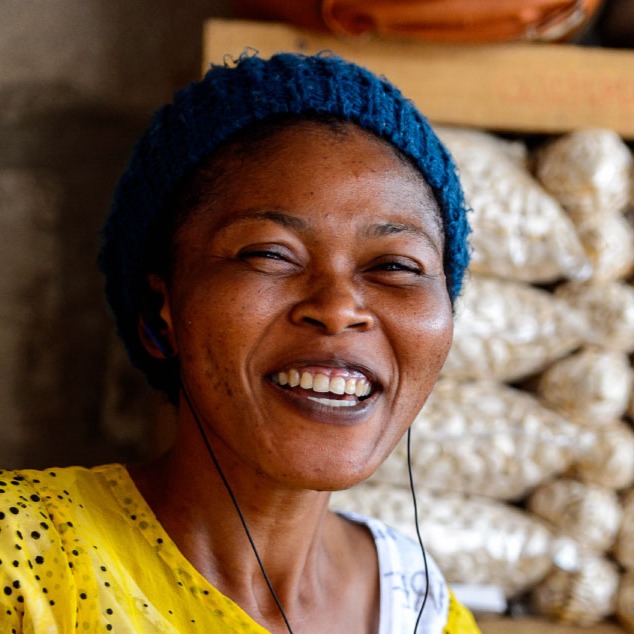
Photo: Anton_Ivanov / Shutterstock.com
Capacity Building: Empowering use for uptake and impact
Capacity building involves a broad spectrum of activities. Not only must gender data users know how to use data, but they must also understand the gender issues reflected in the data. Gender data producers and expert advocates can implement training that addresses knowledge gaps in how to use gender data from different sources and methods.
Enabling gender data use can require taking innovative approaches. It can involve exploring opportunities to harness new innovations in the field of artificial intelligence (AI). It can mean knowing how to create an app to connect other users to the data or to write a compelling news article sharing data-driven insights.

Photo: JunPhoto / Shutterstock.com
IN VIETNAM: Capacity for gender data and issues
Violence against women (VAW) is a difficult subject to address in Vietnam given its traditional taboo nature. The General Statistics Office of Vietnam organized workshops for policymakers to promote data literacy and desensitize the issue. They also involved them throughout design, collection, and analysis of a 2010 VAW survey. This helped create ownership of the data and desensitized the issue. Policymakers used the survey to inform preventative strategies, design responsive services, and measure progress.
Source: Data2X. (2019). Data Breaks the Silence on Violence Against Women: A Case Study of Vietnam. bit.ly/43WJ1G8

Photo: Myroslava Malovana / Shutterstock.com
IN UNITED KINGDOM: Using artificial intelligence
Accessing data and information can be a complex and time-consuming process for many users. The United Kingdom’s Government Digital Service (GDS) is exploring how artificial intelligence (AI) can help different users better access the GOV.UK website. Early experiments in 2018 covered using machine learning to make information easier to find. And by 2024, additional experiments were ongoing to explore how a large language model (LLM) chatbot helps improve access to information across the GOV.UK website.
Source: Bellamy, Chris. (2024). “Experimenting with how generative AI could help GOV.UK users.” Inside GOV.UK. bit.ly/4nnb1ua
Funding: Mobilizing internal and external resources
Promoting gender data use requires sustainable funding from internal sources and targeted external support. It is necessary to budget for data use just as much as data production or methodological work. Its importance must be reflected in budget allocations. The impacts from data use will demonstrate value and further justify future investments.
Despite the pressing need, current funding remains insufficient. Data2X and Open Data Watch estimate an annual gap of $500 million through 2030 to support core gender data systems. More diverse and sustainable funding is needed to support systems for the production and use of gender data.
IN TANZANIA: Mobilizing national resources
Low prioritization of gender data within national policies resulted in few resources allocated to gender data in Tanzania. However, support from UN Women helped ensure that national strategies related to gender policy and statistics explicitly included gender data action and financing plans. This financing supported the production of gender statistics and strengthened institutional capabilities to support gender-responsive policymaking, resulting in the creation of an inter-agency Technical Working Group on Gender Statistics.
Source: UN Women. (2022). “Making Every Woman and Girl Count in Tanzania.” Making Every Woman and Girl Count. bit.ly/3ZHNdXN

Photo: Gonzalo Bell / Shutterstock.com
IN COLOMBIA: Harnessing targeted external support
The need to support capacity building drove Colombia’s National Administrative Department of Statistics (known as DANE) to seek international grants. The Data For Now Initiative supported the development of new partnerships between DANE and academic institutions. This facilitated student engagement at DANE through internships and supported master’s and Ph.D. research using its data. And this partnership also benefited health policymakers through funding projects that captured valuable information for policymakers.
Source: Hansen et al. (2024). Collaboration between national statistical offices and academia. bit.ly/4k7Ro6z

Photo: Felipe Mahecha / Shutterstock.com
Call to Action: What can we do?
Promoting gender data use requires commitment and action from the full array of stakeholders. Data producers, decision-makers, advocates, and donors must work together to achieve the full impact of gender data. Their efforts will overlap and complement each other to transform current practices and fuel a virtuous cycle of gender data use.
The examples this brief has shared from among countless others highlight the opportunities to enable gender data use:
 | Engage with gender data users, from policymakers to citizens, to produce usable gender data that are fit for purpose and open for use. |
 | Establish policies to promote gender data use and work to ensure these policies are put into practice. |
 | Build capacity for working with data and understanding gender issues, harness innovation, and build other necessary skills to use gender data. |
 | Mobilize sustainable funding from internal sources and targeted external funding to drive the full scope of efforts to support gender data use. |
This brief was prepared by Open Data Watch and Data2X. Join us in advocacy to mobilize support for gender data use that will impact the lives of women and girls.
Contact us at: info@opendatawatch.com
Banner photo: Manolo Ramos / Shutterstock.com

Glossary of Terms
Gender data:
Data that are disaggregated by sex, and reflect gender issues, including roles, relations, and inequalities.
Open data:
Data that can be freely used, modified, and shared by anyone for any purpose.
Data uptake:
The process of connecting users with data and making it possible for them to gain insights from the data and act.
Data impact:
The result of using data to inform a decision, alter a condition, or improve well-being.